
Hand Tools vs Power Tools: Which Wins and When
This post contains affiliate links. As an Amazon Associate, we earn from qualifying purchases.
Hand tools excel at precise, one-off tasks requiring feedback and control, while power tools dominate repetitive, high-volume work demanding speed and power. For most hobbyists, a hybrid approach, using power tools for dimensioning and hand tools for joinery, is the most efficient and cost-effective shop strategy.
The common belief that power tools are always faster hinges on a flawed metric. We measure blade contact time, not total task time. For one-off work, the minutes spent setting up a machine, connecting dust collection, and cleaning up often exceed the time needed to simply pick up a hand tool and start working. This is a key consideration in the debate of hand tools vs power tools. The right tool is the one that gets the job done from start to finish with the least friction, not necessarily the most powerful one.
What follows is a breakdown of when each tool type genuinely wins in the hand tools vs power tools debate, grounded in timed comparisons and cost data. We’ll look at speed, cost, precision, and the noise and dust your workspace can handle. By the end, you’ll have a clear framework for choosing between a chisel and a router, or a hand saw and a miter saw, on your next project.
Key Takeaways
- For small-batch work (1-4 pieces), hand tools are often faster than power tools when you include setup and cleanup time.
- A functional starter hand tool kit costs $300–$600, while a comparable power tool shop starts at $2,000–$4,000 before adding dust collection.
- Hand tools offer superior tactile feedback and control for delicate fitting and joinery; power tools provide unmatched speed and consistency for repetitive dimensioning.
- Always maintain a hand-tool backup for every critical power-tool capability in case of power loss or workspace constraints.
- The loudest tool in a typical shop is a router; the quietest workflow uses hand tools plus a cordless drill.
Speed vs. Setup: The Time Trade-Off
The speed myth persists because we watch a table saw rip through a board in seconds. What we don’t clock is the four minutes spent changing the blade, squaring the fence, and rolling out the dust collector. For the single cut you need, a hand saw might have been done already.
David Ohnstad’s timed comparisons are a reality check. He edge-jointed a 36-inch board. Using a benchtop jointer, unplugging other tools, attaching a dust hose, setting the fence, took 4 minutes and 4 seconds. Using a hand plane clamped the board and started cutting. The hand plane finished in 2 minutes and 10 seconds. The hand tool was nearly twice as fast for one board. The power tool only wins when you’re jointing twenty boards in a row, amortizing that setup time.
A 6-inch benchtop jointer costs $350 to $500, weighs 65 pounds, requires 15 amps, and needs a dust collector. A number 7 jointer plane costs $50 to $300 and needs only a sharp blade and a workbench. For the hobbyist truing up four table legs, the plane is faster, quieter, and leaves a glue-ready surface.
The same pattern holds for mortising. Setting up a plunge router with an edge guide, setting the depth stop, and clamping stop blocks took Ohnstad 6 minutes and 57 seconds to cut one mortise. Chopping the same mortise with a chisel and mallet took 4 minutes and 13 seconds. The router is a production beast, but for the four mortises in a table apron, the chisel is quicker. You also avoid the router’s radiused corners that then need squaring with a chisel.
This is the core lesson. Power tools compress time after setup. Hand tools eliminate setup. Your project volume decides the winner in the hand tools vs power tools question.
Cost and Space: The Real Shop Investment
Everyone talks about tool prices. The real financial picture includes space, electricity, and ongoing costs. A hand tool shop fits in a corner. A power tool shop demands square footage and infrastructure.
| Investment Area | Hand Tool Shop | Power Tool Shop | Why It Matters |
|---|---|---|---|
| Tool Kit Cost | $300 – $600 | $2,000 – $4,000 | Covers same core operations: sawing, planing, joining, drilling. |
| Dust Collection | Not needed. | $400 – $1,200 for collector, plus $200 – $600 for hoses. | Required for health and cleanliness with power tools. |
| Shop Space | A sturdy workbench and tool storage. | Dedicated stations for each machine with infeed/outfeed space. | A hand tool shop can operate in a single-car garage space. |
| Power Needs | None. | 15-20 amp circuits, possibly 220V for a cabinet saw. | Older homes or garages may need expensive electrical upgrades. |
| Long-Term Cost | Low. Sharpening stones and occasional replacement blades. | Higher. Motors wear, bearings fail, batteries degrade and need replacing. | Quality hand tools often last a lifetime; power tools have a shorter service life. |
A full hand tool kit, saws, planes, chisels, marking tools, fits in a chest. You can work anywhere with a vise. I learned this after sinking thousands into a cabinet saw, dust collector, and an array of cordless tools. The machines were impressive, but the constant setup and cleanup between steps killed my momentum on small projects. My most productive sessions now happen at my bench with a handful of sharp, simple tools.
For beginners, the cost barrier is the biggest advantage of starting with hand tools. You can own a capable kit for the price of one mid-range power tool. This allows you to find out if you like woodworking before spending thousands of dollars. If you do add power later, you’ll already have the hand skills to handle the fine fitting no machine can do perfectly.
Control, Precision, and Safety
Precision consists of dimensional accuracy and surface quality. A table saw with a crosscut sled delivers perfect, repeatable 90-degree cuts. A sharp hand plane can produce a surface so clean it needs no sanding, something a power planer often can’t do without leaving mill marks.
Hand tools win on tactile feedback. You feel the grain change as you pare a joint with a chisel. You feel the resistance as a screw seats with a hand driver. That moment-by-moment control is why some sources, like Grain & Glue, state hand tools are genuinely better at joinery and fine fitting, while others highlight power tools like the Festool Domino for fast, precise joinery. A router runs at a fixed speed and depth; your feel for the work is indirect.
Common mistake: Assuming a power sander is always faster for surface prep. For a 16×24-inch walnut panel, sanding through four grits with a random orbital sander took 17 minutes. Smoothing the same panel with a number 4 hand plane took 7.5 minutes and produced a superior, finish-ready surface.
Safety is intertwined with control. A hand tool moves only as fast as your arm and stops when you stop. A hand tool’s worst mistake usually results in a bad cut in the wood. A powered blade spinning thousands of times per minute does not care if your attention wanders. The vast majority of serious workshop injuries involve machines. Learning with hand tools is a more forgiving introduction to the craft.
That said, power tools have their own safety advantages for repetitive tasks. Driving 80 deck screws by hand is tiring, and fatigue leads to mistakes and poor driving torque. A cordless drill with a clutch does it consistently and without straining your wrist. The key is respecting the tool’s power and always using push sticks, guards, and eye protection.
Power and Portability: Cordless, Corded, and Manual
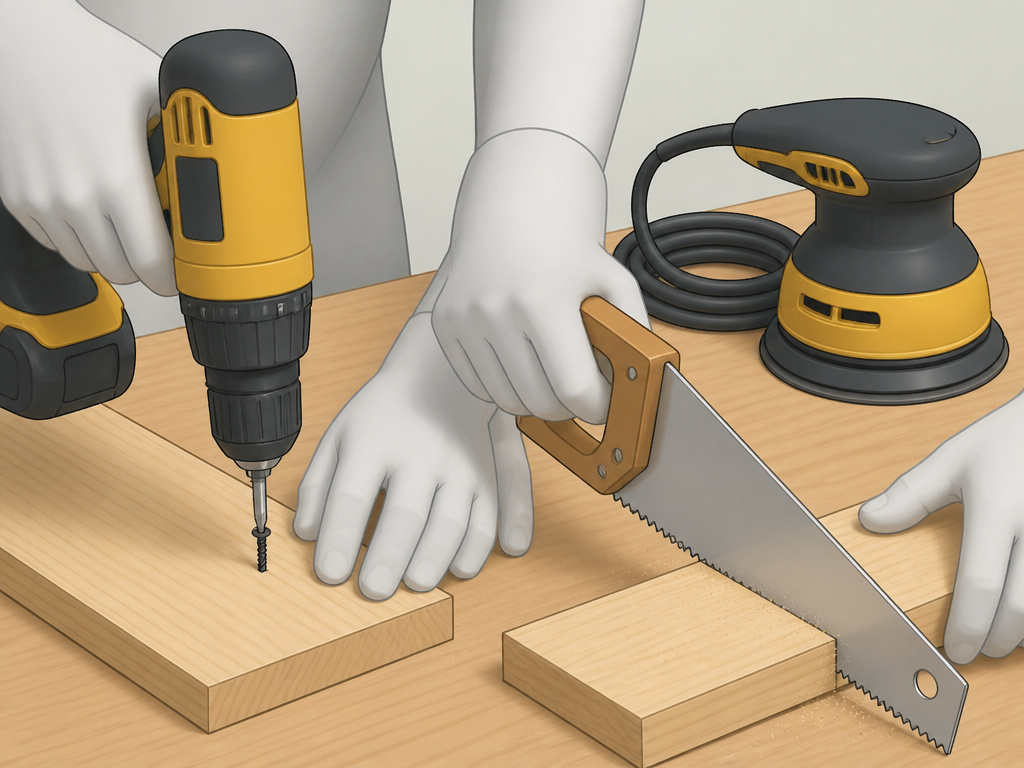
The cordless revolution has blurred the lines, but power sources still dictate where and how you work. Your choice defines your shop’s flexibility.
Cordless Tools offer incredible freedom. An 18V/20V class drill with a 4-Ah battery can drive 80–120 deck screws or drill 40–60 quarter-inch holes in pine before needing a recharge. That’s about 90 minutes of light work or 30 minutes of heavy work. Modern brushless motors deliver sustained power, but you’re always managing battery life. For high-draw tools like a circular saw, runtime plummets. An 18V brushless circular saw might handle 60–100 cuts in 2× framing lumber per 5-Ah battery.
Corded Tools deliver unwavering, unlimited power. You never wait for a charge. The trade-off is the cord itself, a tripping hazard and a limit to your range. They also demand a reliable power source. Running a 1,500-watt circular saw requires a 3,000 W inverter generator or 2,000 Wh power station with 1,800 W continuous output if you’re off-grid.
Hand Tools are the ultimate in portability and independence. They work in a forest, in a blackout, or at midnight in an apartment without a single complaint from a neighbor. This is about workflow, not just for preppers. You can’t run a planer at 9 PM in a townhome, but you can run a hand plane. That time flexibility is a real advantage.
Your best bet is a layered approach. Use cordless tools for primary efficiency, keep hand tools for precision and backup, and reserve heavy-duty corded tools for stationary shop stations where their power is essential. This is the philosophy behind smart planning for cordless vs corded power tools.
Noise, Dust, and Your Workspace
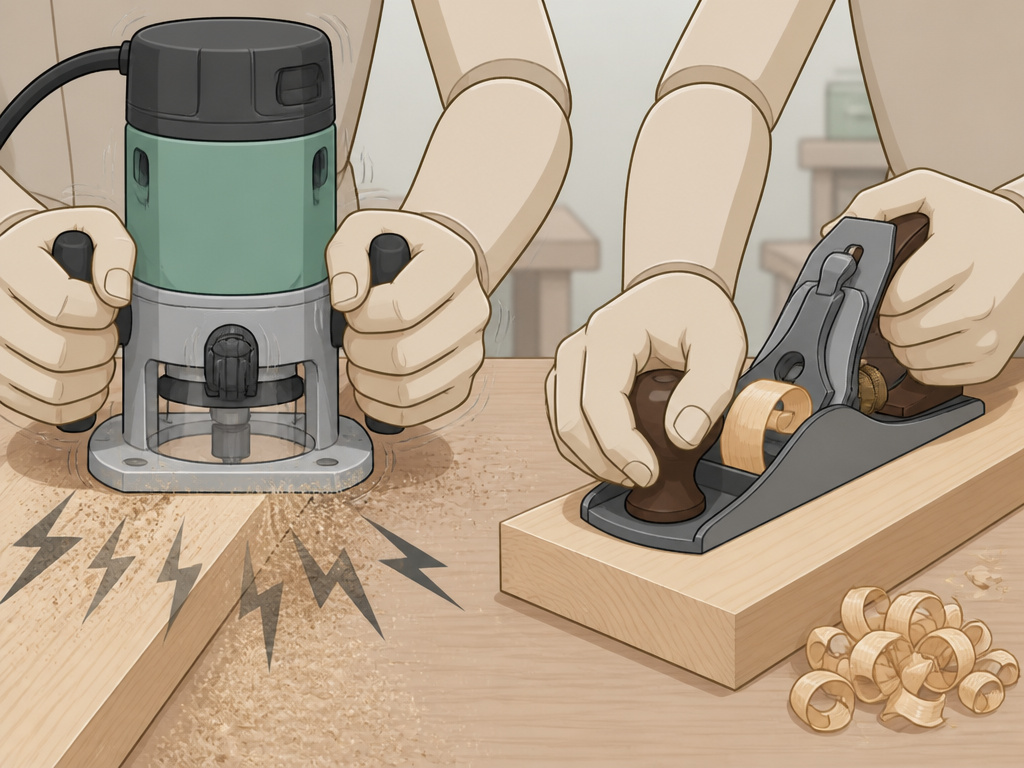
Your shop’s location may decide the tool debate for you. Noise and dust aren’t just annoyances; they are workflow blockers and health concerns.
A router is one of the loudest tools in the shop, often requiring hearing protection. A table saw and dust collector running together can sound like industrial machinery. Hand tools, in contrast, are quiet. You can plane, saw, and chisel while having a conversation. If you share walls with neighbors or family, this difference is everything.
Dust is a more insidious issue. Power tools create fine, airborne particulate that you must manage for your lung health. Even with a dust collector, fine dust escapes and settles everywhere. Hand tools produce shavings and chips, they fall in a pile you can sweep up. There’s no airborne dust. This means you can work without a respirator or a dedicated dust extraction system, which saves you $400 to $1,200 for a collector plus $200 to $600 for hoses right off the bat.
I gave up on all-in-one shop-vac attachments for my power tools after they constantly clogged on fine sawdust. A dedicated dust collection system was the only real solution, adding another layer of cost and setup. Now, for quick jobs, I often reach for a hand tool just to avoid the dust management hassle. It’s cleaner and faster for the one cut I need.
The Decision Flowchart: Which Tool for Which Job?
Lists of pros and cons are helpful, but you need a clear rule for the moment you’re standing in your shop. Use this framework.
- Is the task repetitive? Are you doing the same cut, hole, or fastening more than ten times in a row? If yes, lean toward a power tool. Driving 200 screws? Use a drill. Crosscutting 50 identical chair parts? Use a miter saw.
- Is precision or feel critical? Are you fitting a joint, paring a hinge recess, or working on a delicate material? If yes, lean toward a hand tool. The direct feedback is irreplaceable.
- What’s your batch size? Are you processing 1-4 pieces, or 20+? For small batches, the setup time for power tools often negates their speed advantage. Grab the hand tool.
- What are your workspace constraints? Is it late? Are you in a confined space? Is dust or noise a major concern? If any answer is yes, the hand tool is the better neighbor and the more considerate choice.
The most effective woodworkers use a hybrid workflow. They let power tools do the dimensioning, ripping, crosscutting, planing to thickness, and then switch to hand tools for fitting, joinery, and final surface prep. This captures the speed of machines for the brute-force work and the control of hand tools for the parts that affect fit and finish.
For a beginner, this means starting with a core of hand tools and adding power tools in a logical order. The first power tool should almost always be a cordless drill. After that, consider a random-orbit sander or a circular saw based on your projects. Don’t buy a tool because a kit includes it; buy it because your next project demands it.
Tool Recommendations: Building a Hybrid Kit
You don’t need to choose a camp. Build a kit that does both. Here are the specific tools that form a solid hybrid foundation.
Hand Tools to Start With:
- Bench Chisels (1/4″, 1/2″, 3/4″): For chopping mortises, paring joints, and cleaning up saw cuts. A sharp chisel is the most versatile tool in the shop.
- Block Plane: For trimming end grain, easing edges, and fine adjustments. It’s small, fast to set up, and incredibly useful.
- Quality Hand Saw: A Japanese pull saw or a Western tenon saw for crosscuts and joinery. It’s often faster than setting up a power saw for one cut.
- Marking Gauge & Combination Square: Accuracy starts with layout. These are essential.
- Smoothing or Jointer Plane: For final surface prep and edge jointing. A vintage Stanley #7, tuned up, will outperform many new budget planes.
Power Tools to Add First:
- Cordless Drill/Driver (18V/20V Platform): The one power tool every beginner should own. It eliminates the drudgery of manual drilling and driving. Stick to one major brand (Milwaukee M18, Makita LXT, DeWalt 20V MAX) to share batteries.
- Random-Orbit Sander: This tool sands curves and large flat areas where a hand plane isn’t suitable, and it is one of the least disruptive power tools.
- Circular Saw or Miter Saw: For breaking down sheet goods and cutting long boards to rough length. This is where power tools save significant time and effort.
When choosing between brushless vs brushed power tools, remember that a high-quality brushed motor is often a smarter investment for a DIYer than a cheaply made brushless one. Focus on the tool’s ergonomics and the ecosystem’s breadth, not just the motor technology.
Common Hand and Power Tool Examples
A basic hand tool kit includes items like a hand saw, bench chisels, a block plane, a marking gauge, and a smoothing plane. This collection covers cutting, shaping, and joinery. In contrast, a typical power tool setup for similar operations would include a cordless drill, a circular saw, a random-orbit sander, a router, and a benchtop jointer or planer. The hand tool kit is quiet, clean, and small, while the power tool kit is designed for heavy removal and repetitive tasks like driving many screws or breaking down sheet goods. Each set serves a distinct purpose in the workshop.
Using a Hybrid Tool Approach
Many woodworkers find the best results come from using both hand and power tools together. A common workflow is to use power tools for the heavy, repetitive work like dimensioning lumber, ripping, and initial sanding. Once the parts are at a rough size, you switch to hand tools for the finer work: fitting joints, final smoothing with a hand plane, and detailed joinery. This approach uses the speed of power tools for bulk work and the control and quiet of hand tools for precision. Starting a hybrid shop often begins with basic power tools, then adding essential hand tools like a sharp hand plane and bench chisels.
Frequently Asked Questions
Are hand tools really slower than power tools?
For one-off or small-batch tasks, often no. When you include the time to set up, adjust, connect dust collection, and clean up after a power tool, a hand tool can be faster. The power tool’s speed advantage only appears with repetition, where the setup time is amortized over many identical operations.
I’m a beginner. Should I start with hand tools or power tools?
Most experts recommend starting mostly with hand tools for the first project or two. They are cheaper, safer, and teach fundamental skills about how wood behaves. Add a cordless drill immediately, as it’s a huge time-saver with a shallow learning curve. This approach allows you to learn without spending a lot of money first.
What are the main types of power tools I should know about?
Power tools are broadly categorized by their power source: corded (plug-in), cordless (battery), and pneumatic (air-powered). Common categories include drills, saws (circular, miter, table), sanders, routers, and planners. For a detailed breakdown, see our guide on the different types of power tools.
Is a hand drill a viable alternative to a power drill?
For very occasional use, yes. A brace and bit (a type of hand drill) can drill any hole a power drill can, albeit more slowly. However, for any project involving more than a few holes or screws, the speed and reduced fatigue from a cordless drill make it a worthwhile investment. The hand drill remains an excellent backup and a skill worth knowing.
What safety rules are most important for power tools?
Always wear safety glasses and hearing protection when needed. Never remove guards or disable safety features. Keep your work area clean and well-lit. Use clamps to secure workpieces, not your hands. Most importantly, understand the tool’s operation before you turn it on. For a complete list, review essential protocols for power tool safety.
The Bottom Line
Stop thinking of this as a choice between two teams. You are the foreman, and both hand tools and power tools are crew members with different specialties. Hire the right one for the specific task on today’s docket.
If your shop time is limited to evenings or weekends, and your projects are one-off pieces of furniture, a hand-tool-leaning hybrid shop will get you to the finish line faster and with less frustration. The ability to walk up to your bench and start working without a 15-minute setup ritual is a tangible quality-of-life improvement.
Invest first in the core hand tools, chisels, a plane, a saw, and a cordless drill. Learn to sharpen them until the process is routine. Then, add power tools only when a repetitive task in your project plan justifies the cost and space. Let the work dictate the tool, not the other way around. That’s how you build a shop that serves you, not one you serve.
