
Types of Power Tools Explained: How to Choose
This post contains affiliate links. As an Amazon Associate, we earn from qualifying purchases.
Power tools are broadly categorized by their power source (electric, pneumatic, cordless, powder-actuated), by their portability (stationary vs. Handheld), and by their core function (drilling, cutting, fastening, grinding/sanding). For most home and shop work, electric and cordless tools driven by motors are the go-to choices, while specialized trades rely on pneumatic systems or, in regulated cases, powder-actuated devices.
Those three categories, source, portability, and function, are the skeleton of any power tool guide. But the real difference between a useful overview and a parts list is what you do with that skeleton. A tool’s power source dictates where you can use it and what maintenance it demands. Its portability decides the scale of the project it can tackle. Its function is just the starting point; the specific mechanism inside is what makes a drill different from an impact driver, or a circular saw different from a jigsaw. This is the core of having the types of power tools explained.
What follows is a breakdown of those categories with the specs that matter, the safety rules you can’t skip, and the project-matched recommendations that turn a list of tools into a working toolkit, which is the goal of the types of power tools explained.
Key Takeaways
- Match the power source to your environment: cordless for freedom, corded electric for uninterrupted high power, and pneumatic for industrial workshops with air supply.
- OSHA and manufacturer manuals are not suggestions. OSHA has specific requirements for grinders; for example, requirements apply to hand-held grinders with wheels larger than 2 inches with constant-pressure switches, and to those with wheels 2 inches or less with positive “On-Off” or constant pressure or “Lock-On” control.
- Dust from power sanding or grinding can contain carcinogens; a basic dust mask is insufficient, you need NIOSH/OSHA-approved respiratory protection.
- Tool specifications like voltage, no-load speed, and maximum torque are essential guides to a tool’s capability. Ignoring them leads to underpowered tools and damaged materials.
- Building a system tool-by-tool often beats a pre-packaged kit, letting you select the right battery platform and tool quality for each specific task.
The 3 Main Categories: By Power Source
This is the first and most fundamental split. Your choice here locks in your tool’s tether to an outlet, a compressor, or a battery bay.
Common mistake: Using a corded tool with an extension cord that causes more than a 10% voltage drop. As little as a 10% lower voltage, as noted in the Porter-Cable manual, causes loss of power and results in overheating that can damage the motor.
Electric (Corded): These tools plug into a standard wall outlet. They deliver consistent, unlimited runtime and often higher sustained power than their cordless counterparts. They’re the default for stationary shop tools (table saws, drill presses) and heavy-duty handheld tools like angle grinders and demolition hammers. The trade-off is obvious: you’re limited by cord length and the presence of an outlet.
Cordless (Battery-Powered): Freedom is their currency. Modern lithium-ion batteries offer a great balance of power and runtime. Brands like DeWalt have entire “platforms” where one battery type powers dozens of tools. You’ll find that voltage is the headline spec, with common ranges including 18V/20V for general use. The Evolution R13CMB-Li drill, for example, runs on an 18V (UK/EU/AUS) or 20V (USA) battery. Ambient operating temperature for these batteries is typically 0°C to 40°C.
Pneumatic (Air-Powered): These are the workhorses of professional auto shops and manufacturing. They connect to an air compressor via a hose. Pneumatic tools, like impact wrenches, nailers, and sanders, are known for high power-to-weight ratios and durability. They require a significant upfront investment in a capable compressor and hose system, making them less common for casual DIY. You can dive deeper into the pros and cons in our guide on pneumatic vs electric tools.
Other Sources: Gasoline engines power large outdoor equipment like chainsaws and generators. Hydraulic systems are for extreme force in industrial settings. Powder-actuated tools, which drive fasteners into concrete, operate like a loaded gun. The OSHA hand and power tools guide states they “must be operated only by specially trained employees.”
| Power Source | Best For | Key Limitation |
|---|---|---|
| Corded Electric | Stationary tools, high-draw applications (grinders, saws), workshops. | Tethered to outlet; cord management. |
| Cordless (Battery) | Jobsite mobility, overhead work, quick tasks, general DIY. | Limited runtime; battery degradation over time. |
| Pneumatic (Air) | High-power repetitive tasks (auto repair, framing), professional workshops. | Requires expensive compressor & hose; not portable. |
| Powder-Actuated | Fastening to concrete/steel in construction. | Highly dangerous; requires special operator training. |
Breaking Down Tools by Core Function
Once you know how a tool is powered, the next question is what it does. Grouping by function cuts through marketing and shows you the right tool for the physical task.
Drilling & Fastening
This category is where most confusion lives. A drill and an impact driver look similar but are mechanically different.
- Drill/Driver: The universal tool. Its rotary motion is for drilling holes and driving screws. Key specs are chuck capacity (the size bit it holds) and variable speed. The Evolution R13CMB-Li has a 13mm chuck and two speed gears (0-325 min⁻¹ and 0-1750 min⁻¹).
- Impact Driver: Delivers sudden, rotational bursts (torque) to drive long screws or loosen stubborn bolts. It’s the tool for deck building or assembling furniture. It doesn’t drill clean holes. Max torque is its headline number, the Evolution model cited earlier delivers 45 Nm (33.2 ft/lbs).
- Hammer Drill: Adds a pounding action to rotation for drilling into masonry. It’s a drill with a hammer function, not a dedicated demolition tool.
- Impact Wrench: A bulkier, more powerful cousin to the impact driver, designed for heavy-duty bolting (e.g., lug nuts). Typically pneumatic or high-voltage cordless.
Cutting
The right cutting tool saves time and material. It’s about the kerf (width of the cut) and the control you need. 1. Circular Saw: The go-to for straight, long cuts in lumber and sheet goods. Blade diameter determines cutting depth. 2. Jigsaw: Cuts curves and complex shapes. The reciprocating blade moves up and down. It’s slower but highly maneuverable. 3. Reciprocating Saw (“Sawzall”): A demolition champion. Its push-pull blade chews through wood, nails, pipe, and drywall. Control is low, but power is high. 4. Miter Saw: Makes precise angled and crosscuts in trim and framing lumber. Stationary and essential for finish carpentry. 5. Table Saw: The heart of a woodshop. Provides the most accurate rip cuts (cutting with the grain) and can handle large sheet materials with proper support.
Grinding, Sanding & Finishing
These tools abrade material away. The key choice is the accessory mounted to them.
- Angle Grinder: Perhaps the most versatile, and dangerous, tool here. With the right disc, it can cut metal, grind welds, strip paint, or shape stone. The Bosch 1772-6 grinder has a rated speed of 6,500/min and accepts up to a 7″ grinding or cutting wheel. OSHA has specific requirements for grinders with wheels larger than 2 inches.
- Random Orbital Sander: The standard for smooth finish sanding. Its spinning-and-orbiting motion avoids the swirl marks of a plain disc sander.
- Belt Sander: Aggressive stock removal. It’s for flattening surfaces or quickly sanding large, rough areas.
- Detail Sander: A small, triangular-pad tool for getting into corners and tight spaces.
For a complete look at the different machines for smoothing surfaces, our guide to types of power sanders covers each one’s job.
Essential Safety Rules (That Are Actually Rules)
This isn’t scare talk. It’s the predictable outcome of ignoring documented hazards. The Occupational Safety and Health Administration (OSHA) and every tool manufacturer codify these points because people get hurt without them.
Employees who use hand and power tools and are exposed to the hazards of falling, flying, abrasive, and splashing objects, or to harmful dusts, fumes, mists, vapors, or gases must be provided with the appropriate personal protective equipment. All electrical connections for these tools must be suitable for the type of tool and the working conditions (wet, dusty, flammable vapors). When a temporary power source is used for construction a ground-fault circuit interrupter (GFCI) should be used.
Personal Protective Equipment (PPE) is Non-Negotiable.
- Eyes: ANSI Z87.1 safety glasses. Everyday prescription glasses do not qualify.
- Lungs: NIOSH/OSHA-approved respirator for dust. Sanding dust, especially from materials like lead-based paint or masonry containing crystalline silica, contains carcinogens. A cloth dust mask is not sufficient.
- Ears: ANSI S12.6 (S3.19) hearing protection. Many tools, like grinders and saws, operate above safe noise levels for prolonged exposure.
Tool & Worksite Precautions.
- Inspect Before Use: Check for damage to cords, housings, and switches. Do not use damaged tools.
- Use the Right Accessory: This is critical. Use only impact-rated sockets with impact tools. Ensure accessories are rated for at least the tool’s max speed. A cutting wheel rated for a lower RPM than the tool’s maximum speed can disintegrate.
- Secure Your Workpiece: Use clamps or a vise. Holding material by hand is insufficient and a leading cause of injury.
- Respect the Environment: Do not use cordless tools or chargers in explosive atmospheres. Don’t store tools or batteries where temperatures exceed 40°C (104°F), like in a metal shed in summer.
This is just the framework. A dedicated power tool safety guide walks through the specifics for each tool type.
How to Read Tool Specifications

The marketing sheet shows a shiny tool. The spec sheet tells you what it can actually do. Learning to read it saves you from buying an underpowered drill for concrete or a sander that bogs down immediately.
- Voltage (V): For cordless tools, indicates power potential. Higher voltage (e.g., 18V vs. 12V) generally means more torque and ability to handle tougher jobs. See our comparison of 12v vs 18v tools for a detailed breakdown.
- Amperage (A or Amp Hours, Ah): For corded tools, amperage relates to power draw. For cordless batteries, Amp-hours denote capacity (runtime). A 5.0Ah battery lasts longer than a 2.0Ah battery of the same voltage.
- No-Load Speed (RPM): The maximum rotations per minute a tool can achieve with nothing slowing it down. This matters for drills and grinders.
- Torque (Nm or in-lbs): Rotational force. Critical for impact drivers and wrenches. The 45 Nm from the Evolution drill is a measure of its twisting power.
- Power Source Specifications: Always ensure your electrical supply matches the tool’s requirements (e.g., 120V AC). As the Porter-Cable manual warns, even a 10% voltage drop causes significant power loss and overheating.
| Specification | What It Tells You | Example (from Research) |
|---|---|---|
| Voltage (V) | Power potential of a cordless tool platform. | Evolution Drill: 18V d.c. (UK/EU), 20V d.c. (USA). |
| No-Load Speed (RPM) | Maximum rotational speed of the tool. | Bosch Grinder 1772-6: Rated speed 6,500/min. |
| Max Torque (Nm) | Twisting force for driving or loosening. | Evolution Drill: Max Torque 45Nm (33.2 ft/lbs). |
| Chuck Capacity | Maximum diameter drill bit the tool can hold. | Evolution Drill: Chuck capacity 13mm (8/16”). |
Choosing Tools: Project vs. Trade
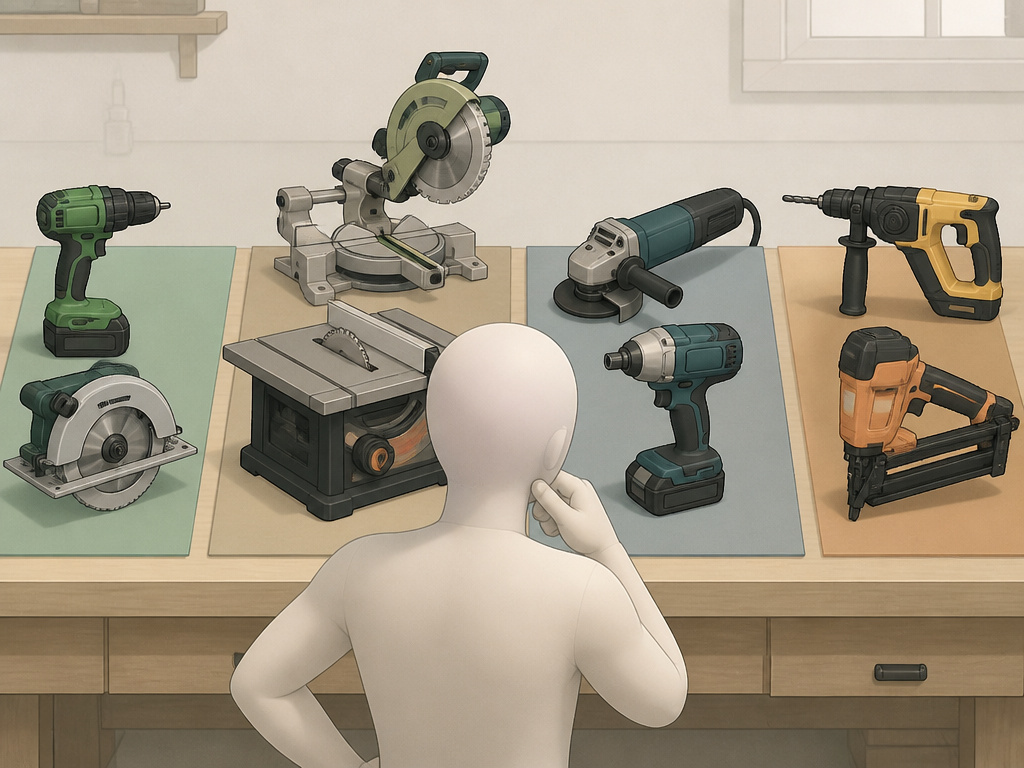
A carpenter’s essential kit differs from a mechanic’s. Here’s how needs diverge.
General DIY / Homeowner:
- Starter Tools: A cordless drill/driver combo kit, a circular saw, a jigsaw, and a random orbital sander will handle a wide variety of projects.
- Power Source Advice: A mid-range 18V/20V cordless platform is common for general use. Consider a combo kit for the initial cost saving, but be critical of the included battery size and the quality of the “free” tools. Often, buying tools individually leads to a better-matched system.
Woodworking / Carpentry:
- Precision Stationary Tools: Table saw, miter saw, drill press, and cordless finish nailer.
- Safety Focus: Dust collection becomes a major health and shop-maintenance concern. Beyond a shop vac, a dedicated dust extraction system is worth the investment.
Metalworking / Automotive:
- Grinding & Cutting: Angle grinder, reciprocating saw with metal-cutting blades, and a powerful cordless impact wrench for lug nuts.
- Power Source: Pneumatic tools still dominate for their power and durability in pro auto shops. High-torque cordless impacts are closing the gap.
Construction:
- Durability & Power: Hammer drill, rotary hammer for masonry, circular saw, and a robust cordless framing nailer.
- Cordless Dominance: Jobsite mobility makes cordless the default, with a focus on high-capacity batteries and fast chargers.
Maintaining Your Power Tools
A well-maintained tool lasts longer and is safer to operate. The basics apply to almost everything.
- Clean After Use: Blow out dust and debris from vents, gears, and battery contacts. For grease or grime, use a mild cleaner. Never use solvents like gasoline or ammonia, as Bosch warns they damage plastic parts.
- Check & Tighten: Before each use, ensure all guards are in place and attachments are securely fastened. Loose parts on a grinder or saw are extremely dangerous.
- Store Properly: Keep tools in a dry place. For cordless batteries, store in a cool, dry location (DeWalt recommends not exceeding 40°C). For long-term storage, manufacturers advise storing batteries in a cool, dry location.
- Know Your Limits: As per DeWalt and other manuals, repairs should be performed by a factory-authorized service center. Don’t open up a tool or battery pack yourself.
Where this goes sideways: Using a worn-out brush in a brushed motor. The commutator gets scored, leading to arcing, loss of power, and eventually a dead motor that costs more to fix than replace.
Stationary vs Portable Power Tools
Power tools are broadly categorized by their mobility. Stationary tools are fixed in place, often with a dedicated work surface, and are used for heavy-duty, precision work on larger materials. Portable tools are designed to be carried to the job site or moved around a workspace, offering flexibility for a wide range of tasks. The choice impacts your workflow; a portable tool is essential for on-site construction, while a stationary tool provides stability for repeated, accurate cuts or shaping in a workshop. Always select the type that matches the scale and location of your project for both efficiency and safety.
Frequently Asked Questions
What are the four main types of power tools by power source?
The four primary types are electric (corded), cordless (battery-powered), pneumatic (air-powered), and powder-actuated. Gasoline and hydraulic are additional categories for very large, specialized equipment.
What’s the difference between a drill and an impact driver?
Drill is for drilling holes and driving screws with steady rotational force. An impact driver delivers high, sudden bursts of rotational torque (impacts) specifically for driving long screws or loosening stuck fasteners. It is not designed for drilling precise holes.
Are cordless tools as powerful as corded ones?
For many common tasks like drilling, driving, and even cutting, modern high-voltage cordless tools are powerful enough. However, for sustained high-draw applications like running a large angle grinder or demolition hammer for extended periods, a corded tool still provides unwavering, full power without battery drain.
What safety gear is absolutely necessary?
At a minimum, you need ANSI Z87.1 safety glasses and task-appropriate hearing protection. When creating dust (sanding, cutting masonry) or dealing with fumes, a NIOSH/OSHA-approved respirator is required, not optional. Gloves are also recommended to protect against vibration and sharp edges.
How do I choose between a brushed and brushless motor?
Brushed motors are simpler and less expensive but have parts (brushes) that wear out and can spark. Brushless motors are more efficient, longer-lasting, and generate more power in a smaller package, but they come at a higher cost. For a deeper dive, our article on brushless vs brushed motors breaks down the pros and cons.
The Bottom Line
Understanding the types of power tools explained is less about memorizing lists and more about matching a tool’s inherent capabilities, defined by its power source and mechanical function, to the job in front of you. Start with the specs; they are the truth behind the marketing. Let the project dictate the tool, not the other way around.
Anchor every decision in safety. The rules from OSHA and the tool manuals exist because the hazards are real and documented. Investing in proper PPE and respecting a tool’s limits isn’t just cautious, it’s how you ensure there’s a next project.
Finally, build your kit intentionally. While a starter combo kit can be a cost-effective entry point, you’ll find greater long-term satisfaction and performance by selecting each tool, and its accompanying battery platform, for the specific demands it will face. Sometimes the right choice is a specialized hand tool, and other times it’s the raw power of a dedicated machine. Your project knows the difference, even if the sales brochure doesn’t.
