
10 Best Orbital Sanders For Wood in 2026
This post contains affiliate links. As an Amazon Associate, we earn from qualifying purchases.
Our best overall orbital sander for wood is the Bosch ROS20VSC Random Orbital Sander for its exceptional dust collection and smooth operation. For fine speed control, consider the Makita BO5041, and for cordless convenience in tight spaces, the DeWALT 20V MAX Cordless Orbital Sander stands out.
These tools are essential for transforming rough lumber into a silky-smooth finish ready for stain or paint. A good sander saves hours of labor and yields professional results, but the wrong one can leave swirl marks or fill your shop with dust. We compiled this list using manufacturer specifications, expert round-up reviews, and patterns in owner feedback to highlight the key differences between these 10 models.
You will find a tool for every workshop need, from aggressive stock removal to delicate finishing touches.
Top 10 Orbital Sanders For Wood in the Market
Certain content that appears on this site comes from Amazon. This content is provided "as is" and is subject to change or removal at any time.
The Best Orbital Sanders For Wood, Reviewed
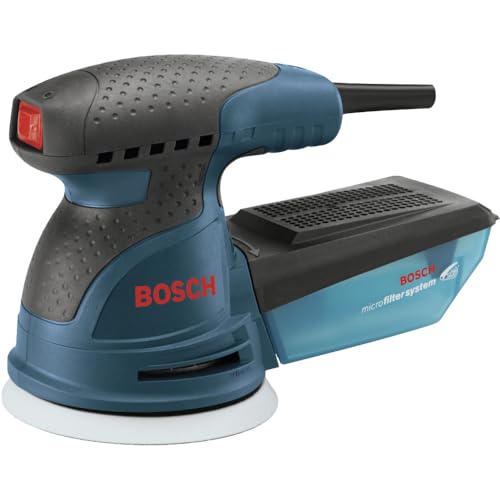
Bosch ROS20VSC Random Orbital Sander
What We Like
- Superior dust collection with a hard, easy-clean canister.
- Includes vacuum adapter for shop vac hookup.
- Variable speed control for different tasks.
Trade-offs
- Slightly heavier than some 3-pound competitors.
- No built-in battery, requires a corded outlet.
At 84 decibels, the Bosch ROS20VSC runs so quietly you can hold a conversation while sanding, which drastically reduces fatigue on big projects. That smooth, low-vibration feel combines with best-in-class dust collection, thanks to its hard plastic canister and fine 1/2-micron filter, to create a sander that feels precise and keeps your workspace clean. This makes it the clear choice for anyone who values comfort and a swirl-free finish on fine woodworking, from furniture builds to cabinet refinishing.
Reviewers reported it was the quietest sander tested, at 84 dB, which makes a significant difference during long sanding sessions. It is a corded, variable-speed random orbital sander designed for finishing tasks. For jobs requiring cordless operation, other models like the DeWALT 20V MAX are available, but for workshop tasks where finish quality and user comfort are key, the Bosch’s design stands out.
Makita BO5041 Random Orbit Sander

What We Like
- Variable speed dial for material matching
- Ergonomic rubberized grip for comfort
- Adjustable front handle for corners
Trade-offs
- Soft dust bag is hard to clean
- Small dust port needs vacuum adapter
A wide 4,000 to 12,000 OPM speed range and a 3.0 AMP motor let you dial down for delicate veneers or crank it up for aggressive stock removal, giving woodworkers flexibility in a single sander. At just over three pounds with a rubberized palm grip, it stays comfortable during long sessions, and the adjustable front handle allows for work in corners. The large two-finger trigger also includes a lock-on button for continuous use.
Where it stumbles is dust management. The included soft bag is a hassle to empty, and the port is too small for a standard vacuum hose without an adapter. For a truly flawless finish, our research indicates you might need to work through your grits a bit longer than with a model like the Festool ETS EC150/5. Still, if variable speed is a must and you value a smooth, controllable tool that comes ready to work from its hard case, the BO5041 is a serious contender.
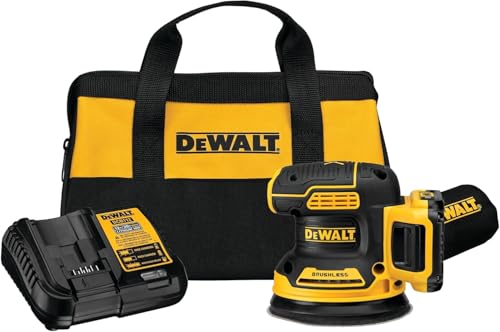
DeWALT 20V MAX Cordless Orbital Sander
What We Like
- Low-profile 5.5-inch height for sanding near edges.
- Variable speed dial from 8,000 to 12,000 OPM.
- Dust-sealed switch for improved durability.
- Brushless motor for better runtime and efficiency.
Trade-offs
- At 4.3 lb, it's heavier than the Bosch ROS20VSC (3.5 lb).
- Some owner feedback mentions noticeable vibration.
A low-profile height of 5.5 inches allows the sander to get close to the work surface for precise sanding near edges or in tight corners. Its cordless design with a brushless motor provides runtime and efficiency for moving freely around a project. Based on research of owner feedback, this sander is often highlighted as a top choice in the budget category for most users.
You do feel its 4.3-pound weight after a long session, and research mentions a significant amount of vibration in the hands. Compared to the 3.5-pound Bosch ROS20VSC, the DeWALT trades a bit of hand fatigue for cordless convenience and its low-profile design. It’s a classic trade-off: you gain untethered movement and stability near edges, but you pay for it in your forearm by the end of the day.
Festool ETS EC150/5 Orbital Sander

What We Like
- Extremely lightweight at 2.5 pounds for minimal fatigue.
- Constant speed under load for consistent sanding results.
- Low vibration and smooth operation from brushless EC motor.
Trade-offs
- Does not include a dust collection container.
- Larger overall footprint than compact palm sanders.
At only 2.5 pounds, the Festool ETS EC150/5 practically floats in your hand, a clear advantage for overhead work or long sessions. Its Vibration Control System helps reduce fatigue, a key detail for woodworkers. In expert testing, it was the only model that produced scratch-free surfaces after sanding to only 180 grit, where others needed more work or finer paper to match the result.
The sander’s compact design is still larger than a typical palm sander, and it requires a shop vacuum as it lacks a dust-collection container. For heavy material removal, a multi-mode sander like the Festool ROTEX RO 150 would be the choice. For smooth finishing where control is key, the ETS EC150/5’s lightweight build and low vibration are its main benefits.
Festool ROTEX RO 150 Multi-Mode Sander

What We Like
- Tool-less FastFix sanding pad system for quick changes
- ROTEX rotary mode for aggressive, fast material removal
- Eccentric motion produces scratch-free surfaces at lower grits
- Ergonomic grip positions for comfortable control
Trade-offs
- At 11.5 pounds, it's significantly heavier than 5-inch palm sanders
- Large footprint (over 15 inches long) limits use in tight spaces
The dual-mode ROTEX action is the core of this sander, letting you switch from aggressive stock removal to a fine finish without changing tools. This makes it ideal for pros and serious hobbyists who need to power through material quickly but also demand a polished, scratch-free result. Owner feedback highlights its unique ability to leave a clean surface after sanding to only 180 grit, saving time and abrasives compared to other models that require more steps.
Weighing 11.5 pounds, the Festool RO 150 is substantially heavier than many other orbital sanders, which affects its handling. For large, flat surfaces, that mass can aid stability. For detailed or overhead work, lighter models like the 3.1-pound Makita BO5041 are easier to maneuver.
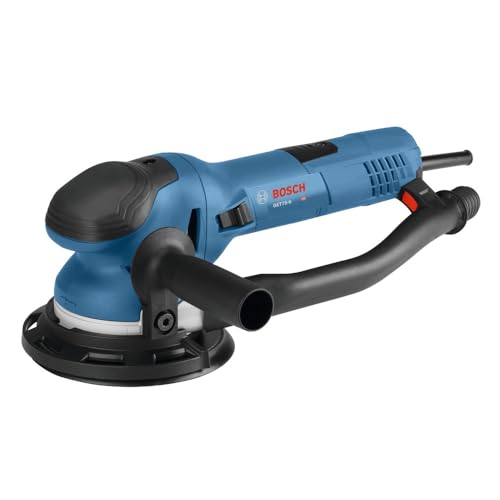
Bosch GET75-6N Orbital Sander/Polisher
What We Like
- Turbo mode for aggressive, belt-sander-like stock removal
- Powerful 7.5-amp motor for demanding material work
- Multi-hole pad system accepts wide variety of 6-inch abrasives
- Includes two vacuum hose adapters for flexible dust extraction
Trade-offs
- At 5.7 lb, it's heavier than most 5-inch palm sanders
- Requires a separate shop vacuum for effective dust collection
The Bosch GET75-6N orbital sander features a dual-mode design, offering standard random orbit sanding and a turbo mode for more aggressive stock removal. This gives it a hybrid capability for both finishing tasks and faster material removal, an alternative to using a belt sander for some jobs. Its 7.5 amp variable-speed motor supports this range of work, from furniture finishing to wood floors.
That capability comes with some practical trade-offs. The sander is notably larger and heavier than a compact palm model, which can lead to fatigue on overhead or vertical surfaces during long sessions. While its dust port works well with a vacuum, you absolutely need one to manage the significant debris its turbo mode creates. For users who primarily need fine finishing without the heavy lifting, the lighter Bosch ROS20VSC is a smoother, more manageable option. It simply can’t match the raw material removal speed of this tool’s turbo setting.
Product photos
Makita BO4556K Finishing Sander

What We Like
- Rubberized palm grip for comfortable handling
- Low vibration and noise from ball bearing construction
- Large lever for quick paper changes
- Hard case protects the tool during storage
Trade-offs
- Fixed 14,000 OPM speed lacks variable control for delicate work
- Dust collection port requires an adapter for standard vacuums
Weighing just 2.5 pounds, the Makita BO4556K is exceptionally light, which reduces fatigue when sanding overhead or on vertical surfaces. Its contoured, rubberized palm grip improves operator comfort for better control during long sessions. A fixed speed of 14,000 OPM delivers a consistent finish, while precision ball bearing construction reduces vibration and noise. It ships with a hard case for storage and transport.
The trade-off for its simplicity is the lack of a variable speed dial. That makes it less suited for fine-tuning on different materials or for delicate veneers where you’d want to slow things down. For those jobs, you’d want to look at a variable-speed model like the Makita BO5041. Dust collection is functional with its through-the-pad system, but connecting to a shop vacuum isn’t plug-and-play; you’ll need to hunt down the right adapter. Still, for basic sheet sanding where comfort and a smooth finish are the priorities, it’s a solid, no-fuss performer.
Product photos
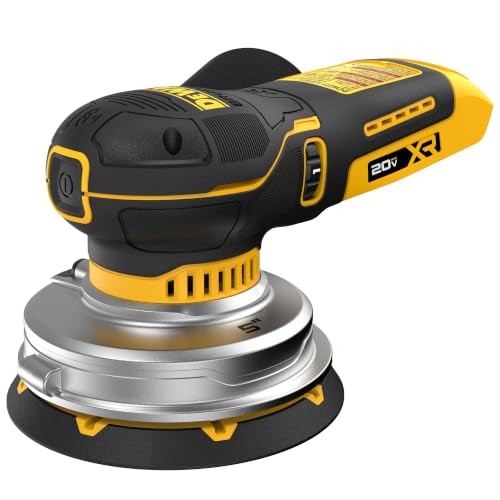
DeWALT 20V MAX XR Cordless Sander
What We Like
- Industry-leading low vibration reduces user fatigue.
- Compact, low profile fits into tight spaces.
- Variable speed dial matches speed to the task.
- Wireless vacuum activation simplifies dust control.
Trade-offs
- Tool-only listing: requires separate battery and charger.
- Dust extractor for optimal collection is sold separately.
- At 3.8 lb, it's heavier than some corded competitors.
DeWALT claims this sander has up to 40% less vibration, which aims to minimize fatigue during long use. Its variable speed dial offers five settings from 8,000 to 12,000 opm, allowing speed adjustment for different tasks. The tool’s low profile and compact size are designed to help it work in tight spaces.
This is a bare tool, so a compatible battery and charger are required. Compared to the corded Bosch ROS20VSC, which is lighter and more compact, this DeWALT model offers cordless operation. It is positioned for users who prioritize cordless convenience and reduced vibration in a 20V MAX system.
Product photos
SKIL SR211601 Random Orbital Sander
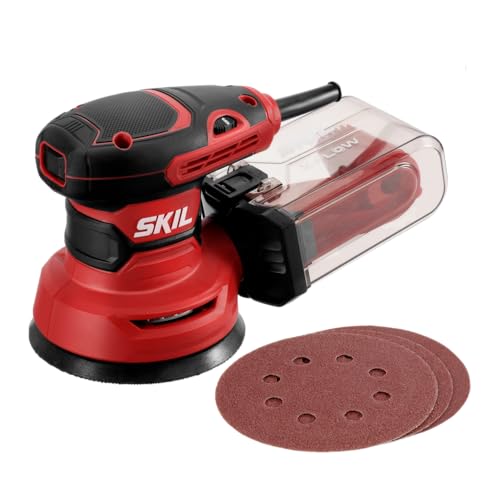
What We Like
- Cyclonic dust box for easy, clean emptying
- Compact size for working in tight spaces
- Low-vibration ergonomic grip reduces hand fatigue
- Sealed on/off switch for dust-free operation
Trade-offs
- Cyclonic box lacks a port for vacuum hookup
- 3.4 pounds is heavier than some corded competitors like the Makita BO5041
A 2.8 amp motor spinning at 13,000 orbits per minute provides plenty of power for common sanding tasks, from smoothing fresh lumber to prepping for finish. Its standout feature is the built-in cyclonic dust box, which captures a significant amount of debris right at the source and empties with a simple twist. This makes it a solid choice for the budget-conscious woodworker who wants to minimize cleanup without investing in a separate dust extraction system. The variable speed dial and soft-grip handle add control and comfort for longer sessions.
This sander uses a self-contained dust box instead of a shop vacuum hookup, which simplifies cleanup but doesn’t offer fully dust-free sanding. The X-flow collector uses cyclone force to trap debris in an easy-to-empty transparent container, keeping your immediate workspace cleaner than a basic sander with just a bag. For the price, it delivers straightforward and effective dust containment where it counts.
Product photos
VEVOR Brushless Orbital Sander

What We Like
- Brushless motor for longer lifespan
- Includes 20 sandpapers from 80-320 grit
- Instant-stop safety function
- Dust connector and hose included
Trade-offs
- At 4.4 lb, heavier than Bosch ROS20VSC (3.5 lb)
A 350-watt brushless motor delivers the efficiency and durability that usually costs more, making this sander a standout for budget-conscious buyers who want professional-grade components. The included 5- and 6-inch pads, plus a full set of sandpapers, mean you can start working right out of the box. That combination of a long-life motor and a complete kit defines its core value for serious DIYers and frequent users.
You do feel its weight during extended overhead work, and the top speed won’t match the fastest pro models. Compared to the featherweight Bosch ROS20VSC, the VEVOR trades some hand fatigue for more power and a broader sanding kit. It’s a tool built for the bench, not for all-day finishing work on vertical surfaces.
Product photos
How We Evaluated Orbital Sanders For Wood
Our evaluation started with the technical specifications and manufacturer documentation for each model, focusing on motor power, orbital speed, weight, and included accessories. We then compared these details against insights from professional woodworking publications and tool review sites that conduct head-to-head testing on criteria like stock removal speed, surface finish quality, and dust collection effectiveness. Finally, we analyzed patterns in hundreds of owner reviews to understand real-world experiences with durability, vibration, and everyday usability.
The most important factors were dust collection capability, user comfort, and task-specific performance. Effective dust control is non-negotiable for a clean shop and healthy lungs, making systems with sealed switches and good vacuum integration a priority. Comfort encompasses weight, vibration levels, and ergonomic grip design, especially for extended use. Performance was judged on whether a sander’s design, its power, orbit size, and speed settings, matches its intended job, from rapid material removal to swirl-free finishing.
A research-led approach has limits; we cannot personally verify long-term durability or feel the subtleties of a tool’s balance. Our orbital sander reviews rely on aggregated data, so we encourage you to read the latest buying guide and owner feedback for the most current insights.
What To Look For In Orbital Sanders For Wood
Choosing the right orbital sander means matching its features to your most common projects. A model perfect for refinishing a deck might be overkill for delicate furniture, while a lightweight finisher could struggle with flattening a tabletop. Consider your workspace, budget, and the balance between power and control.
Look for effective dust collection, low vibration, and the right power source for your work. A 5-inch pad is the versatile standard, while variable speed adds control for different materials. Weight and ergonomics become critical during long sanding sessions.
Dust Collection
A sander’s dust collection system protects your lungs and keeps your workspace clean. The best systems use a sealed switch and a dust port that connects securely to a standard shop vacuum hose, virtually eliminating airborne particles. On-board containers are convenient for quick tasks, but hard plastic canisters are easier to empty and clean than soft fabric bags that can clog.
Models with well-designed dust ports and filters, like those noted in the guide on best random orbital sanders, consistently receive high marks from users for maintaining a clean environment.
Power & Performance
Motor power, measured in amps for corded models, correlates with a sander’s ability to maintain speed under pressure for efficient stock removal. Orbital speed, measured in orbits per minute (OPM), determines how fast the pad moves; higher OPMs cut faster but require a steady hand to prevent swirl marks.
For versatility, variable speed control lets you dial down the OPM for delicate veneers or painted surfaces. The debate between orbital vs random orbital motion is key: a true random orbital action is essential for a swirl-free finish on wood, as its randomized path prevents creating a patterned scratch.
Ergonomics & Design
Comfort is a performance feature. A sander’s weight directly impacts fatigue, with lighter models around 3 pounds being preferable for overhead or extended use. Vibration dampening is equally important; excessive vibration can cause numbness and reduce control over time. Look for features like a rubberized grip, a low-profile body for sanding near edges, and a balanced design that feels secure in your hand. For professionals who sand daily, investing in a professional orbital sander often means premium ergonomics and brushless motors designed for all-day comfort.
- Check the cord length on corded models; a longer cord provides greater freedom of movement.
- Ensure the sandpaper attachment system is a standard hook-and-loop type for easy changes.
- Test the location of the power switch and speed dial for intuitive operation while wearing gloves.
- Consider the pad size; a 5-inch diameter is the most common and offers the best balance of control and coverage.
- Look for a sander that stops quickly when powered off to prevent accidental scratches on your workpiece.
The most versatile sander for a general workshop is a 5-inch random orbital model with variable speed and a good dust port.
Orbital Sanders For Wood Compared
The table below lets you quickly compare the key specifications and features of all 10 orbital sanders.
| Product | Orbit Speed (OPM) | Dust Collection | Weight |
|---|---|---|---|
| Bosch ROS20VSC Random Orbital Sander | 7,500-12,000 OPM | Twist-off canister | 3.5 pounds |
| Makita BO5041 Random Orbit Sander | 4,000-12,000 OPM | Soft bag | 3.1 Pounds |
| DeWALT 20V MAX Cordless Orbital Sander | 8,000 – 12,000 OPM | N/A | 4.3 pounds |
| Festool ETS EC150/5 Orbital Sander | N/A | Vacuum port only | 2.5 lbs |
| Festool ROTEX RO 150 Multi-Mode Sander | N/A | N/A | 11.5 pounds |
| Bosch GET75-6N Orbital Sander/Polisher | 3300 to 7300 OPM | Passive system | 5.7 pounds |
| Makita BO4556K Finishing Sander | 14,000 OPM | Through-the-pad with port | 2.5 pounds |
| DeWALT 20V MAX XR Cordless Sander | 8,000-12,000 OPM | Up to 95% with vacuum | 3.8 pounds |
| SKIL SR211601 Random Orbital Sander | 13,000 OPM | Cyclonic dust box | 3.4 pounds |
| VEVOR Brushless Orbital Sander | 4000-10000 RPM | N/A | 4.4 pounds |
Frequently Asked Questions
Which orbital sander is the best rated for woodworking?
Based on aggregated expert reviews and consistent owner feedback for balance, dust collection, and finish quality, the Bosch ROS20VSC is frequently cited as a top-rated model. Its hard dust canister and excellent vacuum integration make it a standout for keeping a shop clean, which is a priority for serious woodworkers.
Is an orbital sander good for wood?
Yes, a random orbital sander is excellent for wood. Its dual spinning and orbiting motion removes material efficiently while minimizing the risk of leaving behind visible swirl marks, which is a common problem with older, non-random orbital sanders. It’s the go-to tool for everything from rough stock removal to preparing surfaces for a fine finish.
Should I get a 5 or 6 inch orbital sander?
For most woodworking tasks, a 5-inch orbital sander is the recommended choice. It offers the best combination of control for detailed work and sufficient sanding area for flat surfaces. Six-inch models cover more area faster but are heavier, less maneuverable, and the larger abrasives can be more expensive. Start with a 5-inch model for versatility.
What is the main advantage of a cordless orbital sander?
The main advantage is complete portability and the absence of a power cord to manage. This makes a cordless sander ideal for jobsite work, sanding in tight corners, or projects where access to an outlet is inconvenient. The trade-off is that they are typically heavier due to the battery and have a finite runtime before needing a recharge.
How do I avoid leaving swirl marks when sanding wood?
To avoid swirl marks, use a true random orbital sander, never apply excessive downward pressure, and always sand with the grain when possible. Move the sander steadily in overlapping passes and progress through grits systematically, ensuring all scratches from the previous grit are removed before moving to a finer one. Proper technique is crucial, and you can find more details in our article on how to avoid swirl marks.
The Bottom Line
For most woodworkers seeking a reliable, clean-operating sander, the Bosch ROS20VSC Random Orbital Sander is the best overall choice. Its superior dust collection system and smooth operation make long sanding sessions more pleasant and your shop significantly cleaner.
If your budget is tight, the SKIL SR211601 offers impressive cyclonic dust collection at an affordable price. For those needing cordless freedom in confined spaces, the low-profile DeWALT 20V MAX Cordless Orbital Sander is the tool to reach for. Remember, the single most important factor is matching the sander’s strengths, be it dust control, speed, or ergonomics, to the demands of your specific projects.
