
How to Read Power Tool Specifications: Key Specs Explained
This post contains affiliate links. As an Amazon Associate, we earn from qualifying purchases.
To read power tool specifications, you need to separate marketing numbers from the physical, testable data that predicts real-world performance. The key specs are voltage and amperage for power, no-load speed (RPM) for maximum capability, and battery capacity (Ah) for runtime. Cutting capacities, weight, and noise/vibration ratings tell you how the tool will feel in your hands.
That list is what every spec sheet shows you. The trick is knowing which numbers are promises and which are guarantees, which is the essence of how to read power tool specifications. A 20V Max label is a marketing peak; the tool’s continuous amperage draw is the ceiling that decides if your extension cord smokes. A high no-load speed on a circular saw doesn’t guarantee a clean cut through wet lumber, the sustained power under load does.
What follows: a breakdown of each major spec category, grounded in the actual numbers from manufacturer manuals, with a guide on how to read power tool specifications to spot the meaningful differences between a 54V DeWALT saw and a 230V Exact Tools pipe cutter. You’ll learn which numbers to trust, which to question, and how to use them to match a tool to the job you actually do.
Key Takeaways
- Voltage labels are marketing peaks; for corded tools, the continuous amperage rating (like the Exact Tools PipeCut P1000’s 15 A at 120V) is the real limit on your circuit.
- Battery Amp-hour (Ah) ratings directly predict runtime, not power; a 5.0Ah battery will run roughly 2.5 times longer than a 2.0Ah battery on the same tool.
- Noise (LpA) and vibration (ah,W) specs are measured under lab conditions; the Makita JR3070CT manual warns real-world use can differ significantly, so treat them as a baseline, not a promise.
- Always check the standards compliance list (e.g., EN 62841-1:2015); it’s your guarantee that the tool’s safety and performance were tested to an independent, repeatable standard.
Voltage (V) and Amperage (A): The Electrical Foundation
This is where most people get lost in the marketing. For cordless tools, you’ll see labels like 18V, 20V Max, or even 54V. The DeWALT DCS579 circular saw, for example, runs on 54 VDC. That 54V is the nominal voltage of the battery pack under ideal conditions. It tells you the potential electrical pressure, not how much work the tool can actually do or for how long. The real workhorse spec for cordless tools is the battery’s Amp-hour (Ah) rating, discussed next.
For corded tools, the numbers are more direct but just as easy to misread. Look at the Exact Tools PipeCut P1000. Its manual lists two configurations: 1600 W at 230V, or 15 A at 120V. The wattage (W) is a calculated power output (Volts x Amps), but the amperage (A) is the critical number. A 15A draw means it needs a dedicated 15-amp circuit. Plug it into a circuit shared with lights or another tool, and you’ll trip the breaker. That 15A rating is a hard ceiling set by the motor windings and the switchgear inside the tool.
Common mistake: Comparing “20V Max” cordless tools to “15A” corded tools as if they measure the same thing. They don’t. The cordless voltage is a peak battery potential; the corded amperage is a continuous current draw that your wiring must support.
The relationship is simple. Higher voltage (in cordless) or higher amperage (in corded) generally means the tool can deliver more power. But more power is often heavier, more expensive, and overkill for the task. For drilling pilot holes or assembling furniture, a compact 12V system is often the smarter, less fatiguing choice. You can learn more about the relationship between these two key electrical specs in our guide on understanding volts and amps.
| Tool Type | Key Spec | What It Really Means | Real-World Benchmark |
|---|---|---|---|
| Cordless Drill/Driver | Nominal Voltage (e.g., 18V, 20V Max) | Marketing label for battery platform; higher can mean more power. | For 95% of DIY, a quality 12V system is more than enough. |
| Corded Circular Saw | Amperage Draw (e.g., 15 A) | Continuous current the motor pulls from the wall. | A 15A saw needs its own circuit on a 20A breaker to avoid trips. |
| Cordless Saw | Battery Voltage (e.g., 54 VDC) | Electrical potential of the battery pack. | High voltage (40V+) is for sustained heavy cutting in thick material. |
Battery Capacity: Amp-hours (Ah) and Runtime
If voltage is the “pressure” from the battery, Amp-hours (Ah) is the size of the “tank.” A 5.0Ah battery has a larger capacity than a 2.0Ah battery and will run the same tool for a longer period. It does not make the tool more powerful, that’s primarily the motor and voltage’s job. Think of it like a water hose: voltage is the water pressure, amperage is the flow rate, and Ah is how long the flow can last.
That extra runtime (Ah) comes with a penalty in charge time and physical weight. For a full day of framing, the trade-off is worth it. For changing a dozen door handles, it’s dead weight.
The vibration emission during actual use of the power tool can differ from the declared value(s) depending on the ways in which the tool is used especially what kind of workpiece is processed. Source: Makita JR3070CT Manual
This warning applies to batteries, too. The rated capacity is measured under specific lab conditions. Cold weather, old battery age, and running the tool at full throttle will all reduce the actual runtime you get. That’s why for critical, long-duration jobs, having a second battery on the charger is a necessity. For more on choosing the right capacity, our article on the 2Ah vs 5Ah battery trade-off breaks down the practical differences.
Speed (RPM, SPM, No-Load Speed)
This spec tells you how fast the tool’s business end can move when it’s not actually working. It’s a measure of maximum capability, not guaranteed performance under load. You’ll see it as Revolutions Per Minute (RPM) for drills and circular saws, or Strokes Per Minute (SPM) for reciprocating and jig saws.
The numbers vary wildly by tool type. The Exact Tools PipeCut P1000 has a no-load speed selector: 1900/min (low) or 2885/min (high). The DeWALT DCS579 circular saw spins at 5800 RPM. The SKIL RS5884-1A reciprocating saw offers 0–3000 SPM. Higher speeds are generally better for making clean cuts in softer materials like wood or PVC. Lower speeds provide more control and torque for harder materials like metal or for driving screws.
The crucial caveat is in the name: no-load speed. The moment you press a saw blade into a 2×4, the RPM will drop. How much it drops depends on the motor’s power and the electronics for variable speed control. A tool that maintains a high RPM under load is delivering more usable power than one that bogs down immediately. The spec sheet won’t show you that, you need a hands-on review or instrumented test.
Power, usually in watts (W) for corded tools, is a calculated value (Volts x Amps). It gives a general sense of a tool’s overall muscle. The Exact Tools PipeCut P1000 is rated for 1600 W at 230V. That’s a lot of power, which it needs to spin a large blade through thick-walled plastic pipe.
Here’s where marketing gets slippery. Some brands advertise “Unit Watts Out” (UWO) or “Maximum Power Output.” These are often peak numbers achieved for a fraction of a second under ideal conditions. They are not sustainable. The number that matters for continuous work is the rated input wattage (for corded) or the motor’s design, which for modern tools is best indicated by whether it uses brushless motor technology. A brushless motor manages heat and electrical flow more efficiently, delivering more of its rated torque across a longer period without overheating.
| Input Watts (e.g., 1600 W) | Corded Circular Saw, Angle Grinder | Sustained heavy cutting, grinding. | Requires a capable electrical circuit; high wattage often means high weight. | | Unit Watts Out (UWO) | Marketing for various tools | Comparing potential within a single brand’s line. | Not standardized across brands; almost always a peak, not sustained, figure. |
Physical Specifications: Weight, Size, and Capacity
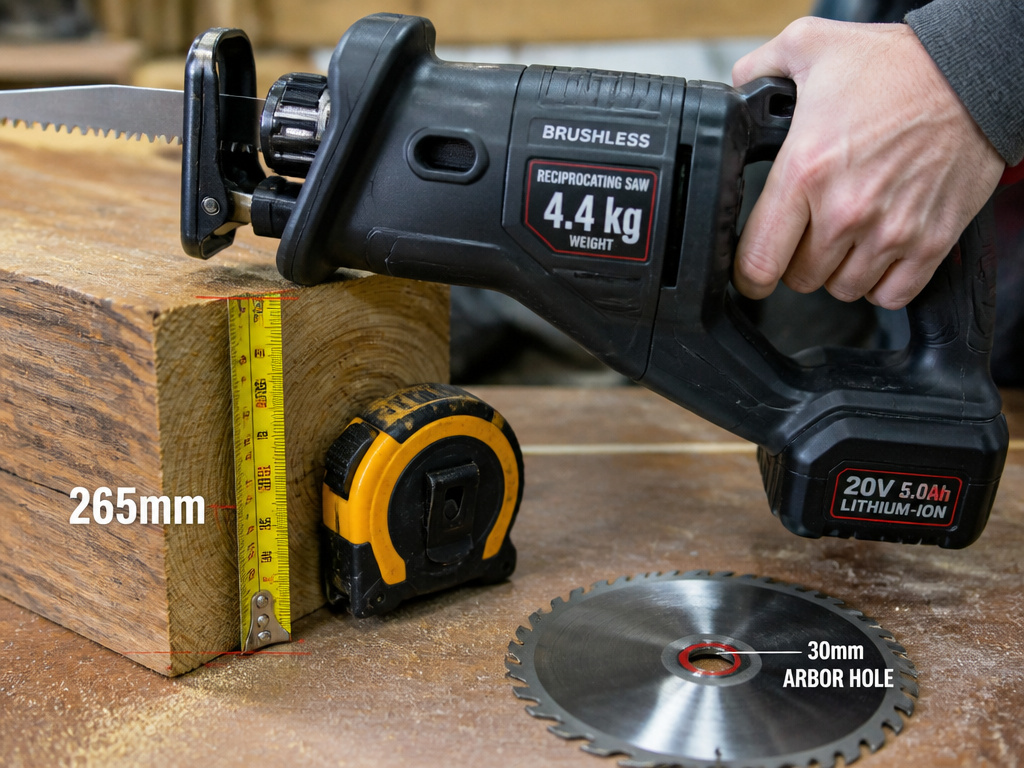
These are the specs that tell you if the tool will fit in your workspace and if you can hold it for the duration of the job.
Weight is listed as “net weight” (tool only) or “weight without battery.” The Makita JR3060T recip saw is 4.4 kg; the JR3070CT is 4.6 kg. That 0.2 kg difference might not sound like much, but after making fifty overhead cuts, you’ll feel it. For cordless tools, remember to add the battery weight, a 5.0Ah battery can add over 1 kg.
Cutting Capacity is the maximum thickness or diameter the tool can handle. It’s specific to the material. The SKIL RS5884-1A can cut through 265 mm of wood but only 30 mm of metal. The Exact Tools PipeCut P1000 handles pipes from 60 mm up to 1000 mm in diameter, with a maximum plastic wall thickness of 75 mm. Exceeding these capacities risks kickback, motor damage, or a ruined workpiece.
Chuck or Arbor Size is critical for compatibility. This is the diameter of the hole in the blade or bit that mounts to the tool. The DeWALT DCS578 uses a blade with a 30 mm or 20 mm bore, as does the DCS579. Using a blade with the wrong bore size requires an adapter, which can introduce wobble and is a safety risk.
Noise and Vibration: The Underrated Specs
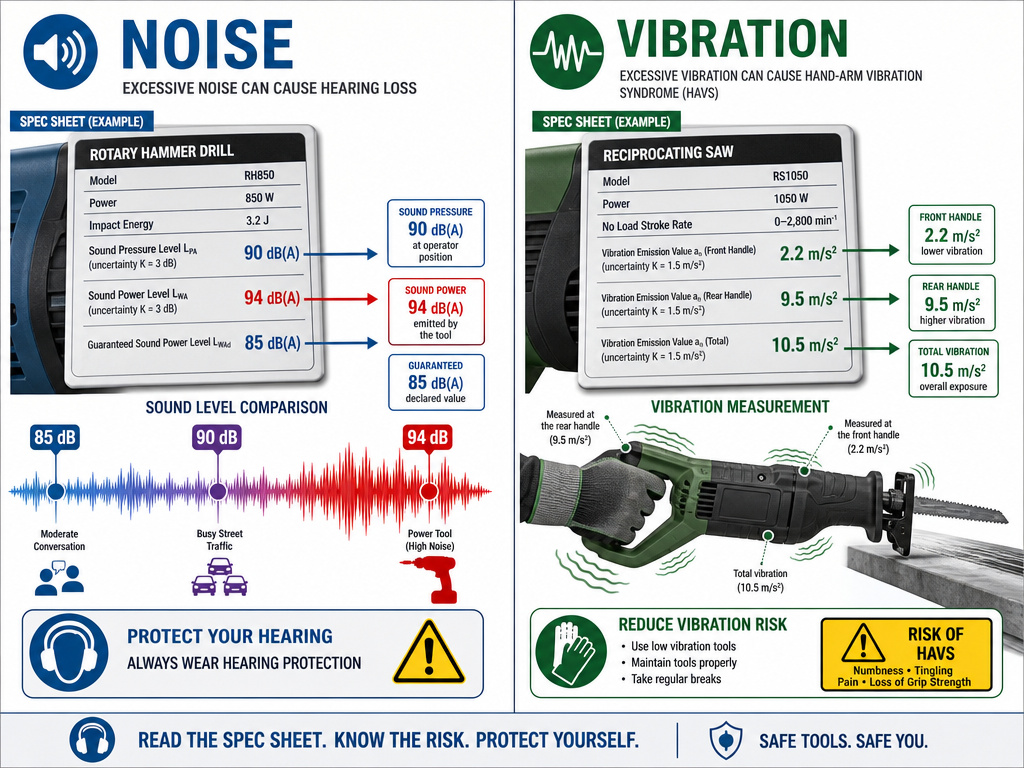
Buried in the compliance section of every manual are two of the most telling specs: sound pressure level (LpA) and vibration emission (ah,W). They are direct indicators of build quality and user fatigue.
The DeWALT DCS579 has an LpA of 90 dB(A) and an LWA (sound power) of 101 dB(A). The Exact Tools PipeCut P1000 is louder, at 94 dB(A) and 105 dB(A) respectively. At 85 dB(A), you need hearing protection for prolonged exposure. At 94 dB(A), you need it for any exposure. These are lab-measured values, and as the Makita manual warns, real-world noise can be higher depending on the material and work environment.
Vibration is measured in meters per second squared (m/s²). Lower is better. The DeWALT saw scores a relatively low 2.2 m/s². The Makita JR3070CT shows how vibration varies with use: 9.5 m/s² when cutting boards, 10.5 m/s² when cutting wooden beams. High vibration doesn’t just fatigue your hands; it accelerates wear on the tool’s internal components. Tools with advanced dampening and brushless motors typically score better here.
Where this goes sideways: Ignoring the LpA rating because you “only use the tool for a few minutes.” Hearing damage is cumulative. That 94 dB(A) saw used for 15 minutes a day over a year is enough to cause permanent loss.
Safety and Compliance: The Guarantee Section
This part of the spec sheet is essential. It lists the safety and electromagnetic standards the tool is certified to meet. It’s your guarantee that the tool was tested by a third party.
The Exact Tools PipeCut P1000 complies with EN 62841-1:2015 (the general safety standard for motor-operated hand tools) and EN 62841-2-5:2014 (the specific standard for circular saws). The DeWALT DCS579 complies with the same, plus the EU’s Restriction of Hazardous Substances (RoHS) directive. These are legal requirements for sale in their respective markets, indicating the housing, electrical insulation, guards, and switches have passed specific tests.
Also listed here are critical safety instructions that are themselves a kind of spec: “Use of power supply via an RCD with a rated residual current of 30 mA or less is always recommended” (Makita). Or “Never service damaged battery packs” (DeWALT, SKIL). These are the manufacturer’s stated conditions for safe operation. Violating them voids warranties and turns the tool into a hazard.
How to Compare Specs Across Brands Effectively
You have two tools with similar prices and what look like similar specs. How do you pick? You move past the headline numbers and compare the measurable, physical data.
First, normalize the units. If one brand lists depth of cut in inches and another in millimeters, convert them. A 67 mm cut (DeWALT DCS578) is 2.64 inches. That 0.14-inch difference might matter for your project.
Second, identify the test standard. If both tools cite compliance with EN 62841-2-5:2014, their depth-of-cut and safety guard tests were performed under the same protocol. That’s a fair comparison. If one tool lacks a stated standard, its numbers are not audited and should be discounted.
Third, focus on the limiting specs for your job. Building a deck? The saw’s depth of cut and weight are your primary guides. Doing fine trim work? The tool’s noise rating and whether it has a soft-start feature to prevent jerking might be more important.
Finally, remember the regional differences. The Exact Tools PipeCut offers different voltage configurations. Ensure the tool you’re looking at is spec’d for your country’s power grid.
TL;DR: Compare only specs backed by a named test standard (EN, ANSI, etc.). Convert all measurements to the same unit. Let the most demanding task you’ll regularly perform decide which spec is the deal-breaker.
Motor Type (Brushed vs. Brushless)
Motor type is a key differentiator in power tools. Brushed motors use physical carbon brushes to transfer power to the armature, which creates rotation through electromagnetic force. Brushless motors, as the name implies, eliminate these brushes and use an electronic controller to manage power delivery. This difference affects performance and maintenance. Brushless motors generally offer greater efficiency, leading to longer runtime on a single battery charge and less heat generation. They also have fewer wearable parts, which can mean less maintenance over the tool’s lifespan. For demanding, continuous applications, a brushless motor is often the preferred choice due to its robust design and improved power delivery.
Frequently Asked Questions
What does “20V Max” on a cordless drill mean?
It’s a marketing term that indicates the maximum, peak voltage of the battery pack when fully charged and under no load. The tool’s nominal, or typical, operating voltage is lower (often 18V). It’s not a lie, but it’s not the whole story, the amp-hour (Ah) rating of the battery and the efficiency of the motor are far better indicators of real-world performance.
How do I understand the specifications of a battery?
Look for three things: Voltage (V), Amp-hours (Ah), and the battery chemistry (usually Li-ion). Voltage suggests potential power. Amp-hours tell you capacity (runtime). The manual will also list important warnings, like the DeWALT and SKIL note that damaged battery packs should never be serviced by the user.
Is a 7 amp drill powerful?
For a corded drill, 7 amps is a robust, professional-grade power draw. It means the motor can sustain high torque for drilling large holes in tough materials. However, for a cordless drill, amperage isn’t used this way; you’d look at the voltage and torque rating (in Nm) instead. Always check if the amperage is for the tool’s motor (corded) or for the battery charger (cordless), they are completely different specs.
What does LpA and LWA mean in the manual?
LpA is the sound pressure level at the operator’s ear, measured in decibels (dB(A)). LWA is the sound power level of the tool itself, a measure of its total acoustic energy output. LpA is what matters for your hearing protection. Any LpA rating at or above 85 dB(A) means you should be wearing hearing protection whenever you use the tool.
Why do two tools with the same RPM feel different?
The no-load RPM is a maximum. The difference you feel is in the motor’s ability to maintain that speed under load (torque), the smoothness of the transmission, and the electronic controls. A tool with a brushless motor and good electronics will feel stronger and smoother than a brushed motor tool with the same listed RPM because it wastes less energy as heat and manages power delivery more intelligently.
Before You Go
Reading a spec sheet is less about memorizing terms and more about learning how to read power tool specifications by asking the right questions. Voltage and amp-hours set the stage. Speed and torque describe potential. But the numbers that truly separate a tool that meets standards like EN 62841-1:2015 from a disappointing one are often the quiet ones: the vibration emission value, the sound pressure level, and the list of safety standards it actually meets.
Treat the headline specs as a starting point for comparison, but let the fine print, the compliance codes, the weight, the real cutting capacity, guide your final decision. And remember the one spec no manual can list: how the tool feels in your hand after the third hour of use. That’s the test that matters most, and it’s why understanding this technical jargon in power tools is the first step toward choosing a tool you’ll enjoy using for years.
