
Can a Nail Gun Kill You? Fatal Risks and Safety Facts
This post contains affiliate links. As an Amazon Associate, we earn from qualifying purchases.
Yes, a nail gun can kill you. Fatalities are rare but documented, with head and chest penetrations being the primary causes. The tool’s lethality hinges on three factors: nail length (over 3.5 inches increases severity), the type of trigger used, and whether the victim was trained. A contact-trip trigger makes a fatal unintentional discharge over twice as likely as a full sequential trigger.
The mechanism is straightforward. A nail fired at high velocity has more than enough energy to penetrate bone and vital organs, which is why one might ask: can a nail gun kill you? A study of accidents from 1985 to 2012 found that the lack of a sequential trigger was a causal factor in over half of serious and fatal cases.
What follows is a breakdown of the data, the engineering, and the single most important decision you can make before pulling the trigger.
Key Takeaways
- The overall injury risk is twice as high with a contact-trip (“bump fire”) trigger compared to a full sequential trigger.
- In a review of 258 serious accidents, 100% of fatalities occurred in the construction industry, and 79.8% of all investigations were in that sector.
- Nails longer than 3.5 inches, common in coil nail guns, are linked to greater injury severity and were involved in a specific 2013 carpenter fatality.
- About 1 in 10 nail gun injuries happen to a co-worker, not the operator, often from an airborne nail or accidental contact.
- If injured, seek medical attention immediately, even for a hand wound that seems minor; infection and internal damage are real risks.
The Fatal Difference Between Trigger Types
This is the single most important spec on the tool. It decides whether the gun fires when you bump it or only when you deliberately make two distinct actions.
A full sequential actuation trigger (SAT) requires a specific order: press the safety tip against the workpiece, then pull the trigger. One trigger pull fires one nail. You must lift the tool and repeat the sequence for the next nail.
A contact-trip trigger (often called “bump fire”) allows you to hold the trigger down. The gun will fire a nail each time the safety tip is pressed against a surface. It’s faster for high-volume “production” work like sheathing, but it removes a critical layer of deliberate action.
The overall risk of nail gun injury is twice as high with a contact actuation trigger nail gun as with a sequential actuation trigger nail gun. This finding is consistent across multiple studies of residential carpenters.
The speed gain is marginal. One study had ten experienced framers build identical small structures. The average nailing time with a contact trigger was 10% faster. That speed accounted for less than 1% of the total project time when cutting and layout were included. The study concluded that the carpenter’s skill impacted productivity more than the trigger type.
So why are contact triggers still so common? The voluntary ANSI SNT-101 standard, revised in 2015, requires manufacturers to include a sequential trigger in the packaging but does not require it to be installed. It also exempts coil nail guns and defines “sheathing” as a “production application,” allowing contact triggers in that common construction task, a point NIOSH disagrees with, recommending no such exemptions.
NIOSH disagrees. They state the revised ANSI standard “does not reflect current scientific research evidence and is therefore not sufficiently protective of workers.” Their position is clear: there is no safety basis for exempting any construction task or tool type from the safer trigger requirement.
| Trigger Type | How It Works | Best For | Injury Risk |
|---|---|---|---|
| Full Sequential (SAT) | 1. Press tip to work. 2. Pull trigger. One nail per cycle. | All work, especially placement (holding lumber), and for inexperienced users. | Half the risk of a contact-trip trigger. |
| Contact-Trip (“Bump Fire”) | Hold trigger down, bump tip to fire repeatedly. | High-volume flat work (e.g., sheathing subfloors) where hands are clear. | Twice the risk of a sequential trigger. Unintended discharge is common. |
The math is not subtle. If you’re asking about lethality, start with the trigger, which is central to the can a nail gun kill you inquiry. A sequential trigger is the most effective engineering control you have.
Anatomy of a Nail Gun Fatality
What does a fatal accident actually look like? It’s not a Hollywood explosion. It’s a specific sequence of tool, position, and trajectory.
Consider a real case from 2013, detailed in a CDC report. A carpenter was killed by a nail from a Paslode Model F350S pneumatic nail gun. The nail was a 3-inch smooth shank. It entered through his eye socket and lodged in his brain, causing fatal head injuries.
This case highlights the lethal variables: a long nail (3 inches), a pneumatic tool with enough power to drive it through bone, and a trajectory involving the head. The New Zealand Department of Labour has a blunt rule: any tool that can drive a fastener longer than 50 mm (about 2 inches) in any mode other than sequential should be withdrawn from service on a construction site.
Fatalities are a small percentage of the roughly 37,000 emergency room visits nail guns cause each year. But the severity is absolute. A review of 258 serious and fatal pneumatic nail gun accidents in the U.S. (1985-2012) found that 100% of the fatalities occurred in construction. In 77.7% of these serious cases, the victim was the operator.
Where this goes sideways: Using your non-dominant hand or working in an awkward position. A Michigan OSHA report describes a carpenter fatally shooting himself in the face. He was in an awkward stance, using his non-dominant hand, when a reported “double-fire” knocked him off balance, directing the nail into his head.
The lack of training is the silent partner in these events, especially when you compare a can a nail gun kill you scenario with proper safety knowledge. In that same review of 258 cases, 95% of the report summaries did not describe any prior nail gun safety training for the victim. Only 3% positively affirmed the operator had been trained.
Statistics: How Common Are Serious Injuries?
The numbers tell a story of constant, preventable harm. According to CDC/NIOSH, nail guns are responsible for about 37,000 emergency room visits each year. Separately, CDC MMWR data from 2001-2005 shows an annual average of 22,200 ED-treated injuries among workers and 14,800 among consumers.
For consumers, the trend is alarming. In 2005, consumer nail-gun injuries were approximately three times higher than in 1991. The tools became cheaper and more available at home centers, moving a major occupational hazard into garages and backyards.
The body parts hit are predictable. Hands and fingers are the most commonly injured body parts in both consumer and worker nail gun injuries. Lower extremities (legs, feet) are next. These are often self-inflicted wounds from holding lumber or a misfire when lowering the tool.
But about 1 in 10 injuries happens to a co-worker. This is the bystander risk, a nail that misses, passes through material, or is fired accidentally when someone bumps the operator. This shows why jobsite procedures and trigger choice matter to everyone on site.
The most telling statistic is the preventive power of the right trigger. Injury surveillance indicates approximately 65%–69% of injuries from contact-trip tools could be prevented by using a sequential-trip trigger. That’s not a marginal gain. It’s a two-thirds reduction.
Immediate First Aid for a Nail Gun Injury
You have a nail in your hand. Or your co-worker just got one in the leg. What you do in the first minutes matters. The goal is to stabilize the situation and get professional help without making things worse.
Do not remove the nail. This is the first and most critical rule. A nail acts as a plug, limiting bleeding. Pulling it out can cause significant additional tissue damage, severe bleeding, or worsen an internal injury you can’t see.
- Call for emergency medical help immediately. Dial 911 or your local emergency number. This is not a “drive yourself to urgent care” injury.
- Keep the victim still and calm. Movement can shift the nail. Have them sit or lie down in a comfortable position.
- Stabilize the nail and the injured body part. If possible, use rolled-up cloths or towels to create a bulky dressing around the nail to prevent it from moving. Do not apply direct pressure on the nail itself. Try to immobilize the joint above and below the injury.
- Control any bleeding. Apply gentle pressure around the wound site, not on the nail. Use a clean cloth if available.
- Monitor and wait. Watch for signs of shock (pale skin, rapid pulse, dizziness). Keep the victim warm until EMS arrives.
Seek medical attention immediately after nail gun injuries, including hand injuries that appear minimal. The CDC is explicit on this. Even a small puncture can drive bacteria and debris deep into tissue, leading to serious infection or tendon damage that isn’t immediately apparent.
Hospitals are equipped to handle this. They will take X-rays to see the nail’s path, administer a tetanus shot if needed, provide antibiotics, and surgically remove the nail in a controlled environment. Trying to DIY this is how a simple injury becomes a complex, lifelong problem.
Safety Mechanisms and Rules That Actually Work
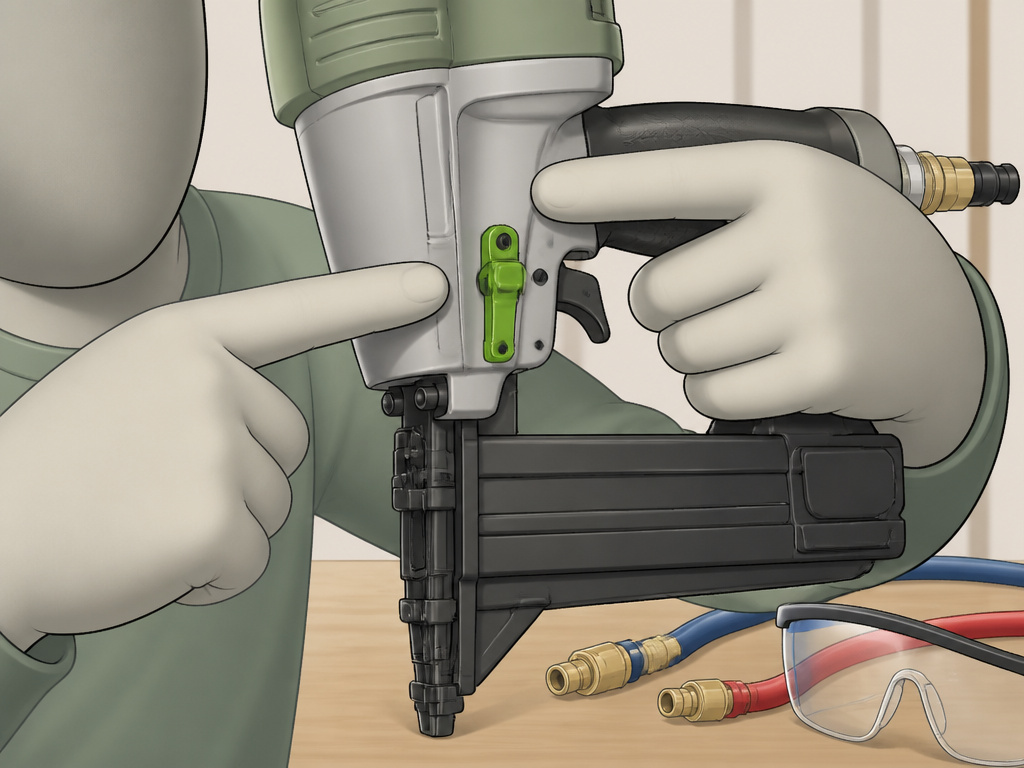
Safety is about using the systems built into the tool and the job. Relying on personal vigilance against a 140-fps projectile is a losing strategy.
The foundational rule is always treat a nail gun as if it’s loaded and ready to fire. Assume the air hose is connected, the magazine is full, and the trigger is live. That mindset changes how you carry it, point it, and set it down.
Use the Full Sequential Trigger. This is essential for anyone new to the tool or for tasks where your hands are near the nailing point. If your nail gun didn’t come with one, contact the manufacturer or supplier to purchase a full sequential trigger kit. Don’t settle for a “single sequential” trigger that resets differently; you want the full SAT.
Establish and follow work procedures. This is especially critical on a jobsite.
- Maintain a clear work zone. Maintain a clear work zone to keep co-workers and bystanders away from the nailing area.
- Never bypass or disable safety mechanisms. This includes trigger locks, contact elements, or muzzle guards. OSHA citations and penalties are directly linked to this.
- Disconnect the air supply when clearing a jam, performing maintenance, or passing the tool to another person. Don’t just set it down.
Wear appropriate Personal Protective Equipment (PPE). At a minimum, this includes:
- Safety glasses with side shields. Nails can ricochet, and concrete or metal can spit back chips.
- Hearing protection. Pneumatic nail guns operate at noise levels that can cause long-term hearing damage.
- Hard hats on construction sites.
- Sturdy work boots with slip-resistant soles.
Training is the thread that ties it all together. Both new and experienced workers need regular refreshers on the causes of nail gun injuries. The CDC nail gun safety guide and the official OSHA nail gun PDF are the primary resources for building a training program. An untrained worker is simply more likely to get hurt.
Types of Nail Guns and Relative Risks
Not all nail guns pose the same level of danger. The power source and nail capacity change the risk profile.
Pneumatic Nail Guns are the most common in construction. Powered by an air compressor, they are responsible for the vast majority of injuries and all fatalities in the studies cited. Their high power allows them to drive long nails into dense wood, which also means they can penetrate the human body with ease. Understanding the different trigger modes for nail guns is the core of safe operation.
Coil Nail Guns are a subtype of pneumatic nailer that hold nails in a coil. They are explicitly exempted from the sequential trigger requirement in the ANSI standard, a point of major contention with NIOSH. The concern is valid: some coil nail guns can accommodate nails longer than 3.5 inches, which are associated with greater injury severity. There is no logical safety reason for this exemption.
Cordless/Battery-Powered Nail Guns are growing in popularity. They are generally less powerful than pneumatic models, which somewhat reduces penetration risk, but they are still fully capable of causing serious injury. They often come with sequential-only triggers, which is a safer default.
Powder-Actuated Tools (PATs) are in a different category. They use a .22 caliber powder charge to drive a fastener into concrete or steel. They are significantly more dangerous than pneumatic nail guns and require special operator certification. Their safety protocols are distinct, and confusing them with a standard nail gun is a serious error. Our dedicated guide covers the safe operation of powder-actuated tools.
For the homeowner or DIYer, the safest path is a cordless nailer with a sequential trigger, matched to the scale of your projects. For professionals, the data demands a shift toward sequential triggers as the default, not the exception.
Frequently Asked Questions
What happens if you get hit by a nail gun?
You will have a puncture wound, often with the nail still embedded. The severity depends on the nail’s length, location, and path. A nail in the hand might damage tendons and bones, requiring surgery. A nail in the torso could puncture a lung or organ, causing life-threatening internal bleeding. The immediate steps are to call 911, keep the victim still, and not remove the nail.
How much damage can a nail gun do?
Significant damage. Beyond the immediate puncture, nails can fracture bones, sever tendons and nerves, and cause permanent loss of function. Even after proper removal, deep infections like osteomyelitis (bone infection) are a serious risk. The PMC serious injury investigation study details cases of permanent disability from non-fatal strikes.
Is a nail gun fatal?
Yes, but it is statistically rare compared to the total number of injuries. Fatalities almost always involve penetration of the head or chest. The MMWR emergency department injury report shows that while most people are treated and released, thousands are hospitalized each year for severe embedded wounds.
Can nail guns be used as a weapon?
Legally and practically, they are tools, not weapons. However, their misuse in assaults or suicides has been documented in forensic literature. The kinetic energy of a fired nail is sufficient to be lethal. This is why treating them with the same respect as a firearm, focusing on muzzle awareness and trigger discipline, is a sensible safety practice.
The Bottom Line
The question is what specific decisions make a nail gun killing you more or less likely. The evidence from two decades of research points to one lever you can pull today: switch to a full sequential trigger.
If your nail gun has a contact-trip trigger, order the conversion kit. If you’re buying new, insist on a sequential trigger. This one change addresses the causal factor in the majority of serious accidents. Pair it with real training, not just a quick demo, and enforce basic safety procedures like disconnecting the air when not in use.
The data shows consumer injuries tripling as these tools hit the mainstream. The professional standard, ANSI SNT-101, still has exemptions that safety scientists at NIOSH call insufficient. In that gap between what’s allowed and what’s proven safe, your own choices are the final guard. Choose the trigger that forces a pause. Your hands, your eyes, and the person working next to you are worth the 10% trade-off in speed.
